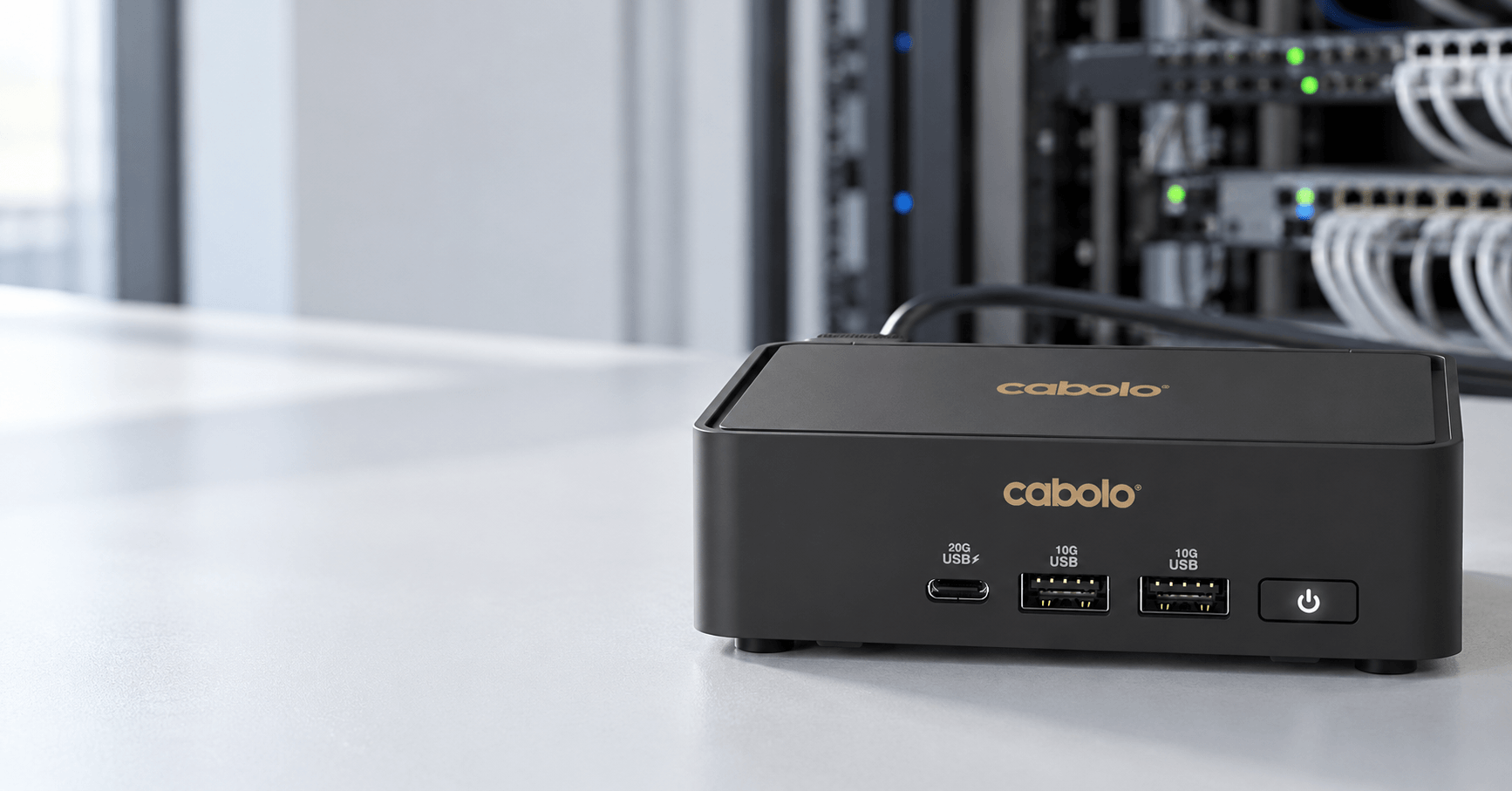
Built for your network, not the cloud
Secure AI only stays secure if it fits the network it sits on. CABOLO® now ships with a network module that lets IT teams connect, authenticate and manage the device on their own terms, with no cloud dependency and no command-line work.
In parliaments, courts, ministries and boardrooms, every new device has to pass the same test. Can it join a locked-down network? Will it respect the existing addressing plan? Can IT prove what was changed, and when? An AI tool that fails any of these never leaves the pilot stage.
CABOLO® was built to process speech entirely on-premises. The network module extends that principle to connectivity: the device works inside your infrastructure, follows your policies and keeps your data where it belongs.
Proves its identity before it joins
Many government and corporate networks admit only devices that can prove who they are. This is the 802.1X standard: without valid credentials, a device stays offline even with the cable plugged in.
CABOLO® supports all three common 802.1X methods, so it fits most existing networks:
- TLS, using a device certificate and private key, for high-security sites that issue their own certificates.
- PEAP, using a username and password inside an encrypted tunnel, common on Windows-based corporate networks.
- TTLS, the same approach for mixed networks with varied client systems.
Certificates are checked before use. Passwords and key passphrases are masked in logs and API responses, and are never shown back on screen.
Fits your addressing plan, not the other way round
The built-in Ethernet port runs at 2.5 Gbps. A USB Ethernet adapter, detected automatically when plugged in, adds a second port at up to 10 Gbps depending on the adapter. It can carry extra capacity or act as a backup path if the main connection fails.
Each port can use automatic addressing (DHCP) or a fixed address. An optional VLAN tag places the device in its own network segment, so sensitive traffic stays separate from the rest of the site. Your IT team keeps its existing plan and adds CABOLO® without rewiring.
Each unit can also carry its own device name, following the site’s naming scheme. On a site with several CABOLO® devices, staff can tell them apart in logs, network lists and support calls.
Audio and data, kept apart
Many CABOLO® installations sit inside professional audio-video systems running Dante audio over IP. Plenary halls, council chambers and conference venues often carry live audio and ordinary data on the same infrastructure.
With the network module, the two can run on separate ports. Dante audio can use the built-in Ethernet port with its own address, while data runs on a USB Ethernet adapter with a different one. Each port is configured and applied on its own, so a change to the data connection does not interrupt live audio.
Its own wireless network, when you need one
CABOLO® can broadcast its own Wi-Fi network. This gives a technician a direct connection on site, supports temporary setups in the field, and lets the device work where no site network is available.
The access point supports Wi-Fi 4, 5 and 6, with WPA2, WPA3 or mixed WPA2/WPA3 security, so older and newer devices can both connect. A country setting applies local radio rules, and any channel that cannot be used is refused with a clear reason before it is applied.
Changes that are checked, contained and recorded
Network changes on a live device carry risk. The network module is designed to keep that risk low:
- Checked first. Every setting is validated before it is applied, and invalid values are refused with a clear message.
- Contained. A change applies only to the connection being edited, so other connections keep running.
- Reversible. If a change fails, the previous working setup is restored automatically.
- Recorded. Status reports and audit events show what was changed, supporting your IT governance.
Most installations need only the default settings. When a site has specific requirements, IT staff can fine-tune every option from the device’s management interface.
Ready for IT policy from day one
Offline processing keeps your speech data on-premises. The network module makes sure the device itself meets the same standard: authenticated, segmented, auditable, and managed by your own team.